
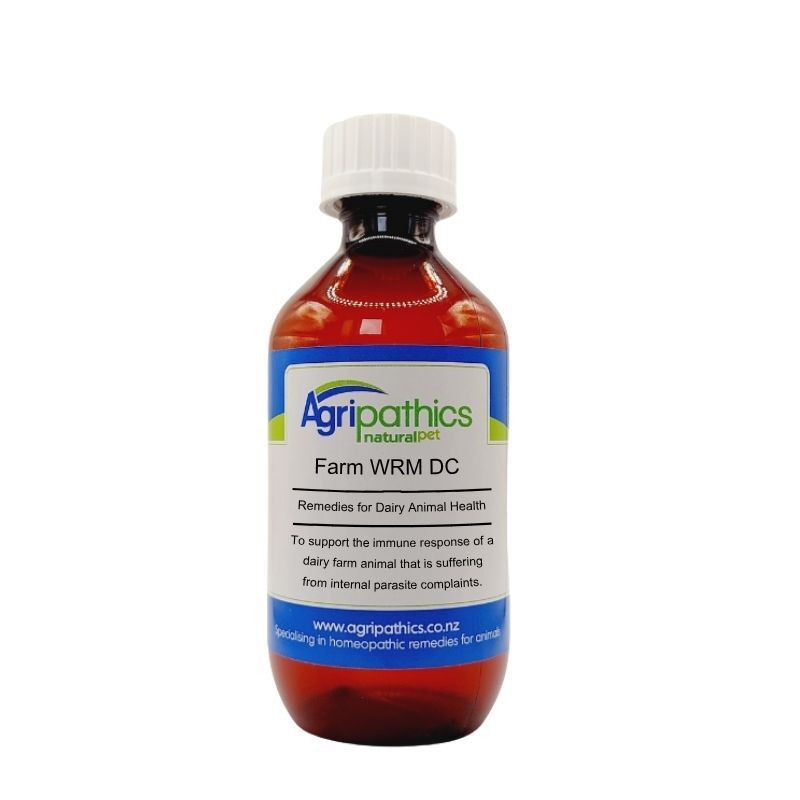

Supports dairy cattle as part of an integrated worm and parasite management programme.

Farm WRM for internal parasite support in dairy cattle
Farm WRM is a homeopathic remedy traditionally used to support dairy cattle as part of a comprehensive worm and parasite management programme. It is commonly selected to support animal wellbeing, condition and resilience during periods of parasite challenge.
Information
Supporting parasite management in dairy cattle
Internal parasites are a common challenge for dairy cattle and can affect growth, condition, feed conversion and overall performance. Effective parasite management involves a combination of nutrition, pasture management, monitoring and strategic parasite control.
Farm WRM is traditionally used as part of a broader herd health programme designed to support cattle during periods of increased parasite pressure.
When might Farm WRM be considered?
Farm WRM is traditionally used where dairy cattle may be experiencing signs associated with:
- Internal parasite challenges
- Worm exposure
- High parasite pressure
- Poor thrift
- Reduced condition
- Seasonal parasite burdens
- Young stock worm management
- Pasture-related parasite exposure
- Herd parasite control programmes
- General wellbeing during parasite challenge
Understanding parasite pressure on dairy farms
Parasitic worms are a natural part of many grazing systems. Environmental conditions, stocking rates, pasture contamination and animal age can all influence parasite exposure.
Young growing cattle are often more susceptible to parasite burdens, although adult cattle can also be affected during periods of increased challenge.
Farm WRM is traditionally used as part of an integrated approach to herd wellbeing and parasite management.
Supporting young stock and replacement animals
Young stock often face greater parasite challenges while their natural immunity develops.
Farmers commonly focus on:
- Good nutrition
- Appropriate pasture management
- Regular monitoring
- Maintaining growth rates
- Reducing unnecessary stress
- Supporting overall health and resilience
Farm WRM may be incorporated alongside these management practices as part of a comprehensive young stock programme.
Supporting condition and performance
Maintaining good condition is important for productivity, fertility and overall animal wellbeing.
Farm WRM is traditionally used to support:
- General wellbeing
- Healthy growth
- Feed utilisation
- Animal condition
- Performance during periods of parasite challenge
Integrated parasite management
Successful parasite control often relies on a combination of management strategies.
These may include:
- Grazing management
- Pasture rotation
- Monitoring parasite burdens
- Strategic worm control programmes
- Nutrition management
- Young stock monitoring
Farm WRM is commonly incorporated into broader farm parasite management systems.
Seasonal parasite support
Parasite challenges can fluctuate throughout the year depending on weather conditions, pasture growth and grazing pressure.
Many dairy farmers choose Farm WRM during periods traditionally associated with increased parasite activity and exposure.
Frequently asked questions
What is Farm WRM used for in dairy cattle?
Farm WRM is traditionally used to support dairy cattle during periods of parasite challenge and as part of a comprehensive worm management programme.
When might Farm WRM be considered?
It is commonly selected during periods of increased parasite exposure, for young stock management and as part of seasonal parasite control programmes.
Can Farm WRM be used in calves and young stock?
Yes, Farm WRM is commonly used in young growing animals as part of a broader parasite management and wellbeing programme.
Can Farm WRM be used in adult dairy cows?
Yes, Farm WRM may be used in adult dairy cows as part of herd health and parasite management programmes.
Can Farm WRM replace normal farm parasite management practices?
Farm WRM is traditionally used alongside good pasture management, monitoring, nutrition, conventional products and other farm management practices as part of a comprehensive approach to parasite control.
Can Farm WRM be used alongside other Agripathics remedies?
Yes, it is commonly used alongside remedies selected for digestive health, general wellbeing and mineral support.
How is Farm WRM administered?
The remedy may be sprayed directly onto the nose, added to feed or added to drinking water for herd-wide support.
About Agripathics
Agripathics is a proudly New Zealand-owned and operated range of handmade homeopathic remedies developed specifically for farm and production animals. Created by qualified Animal Homeopath Paulette Carpenter, the range supports the health, wellbeing and resilience of dairy cattle, horses, poultry, sheep and other farm animals through all stages of life and production.
Developed from decades of practical farming and animal health experience, Agripathics remedies are trusted by farmers throughout New Zealand for use in everyday herd, flock and stable management. From calving and mastitis support through to injury, stress, digestive health and general wellbeing, every remedy is crafted with care using traditional homeopathic principles and quality ingredients.
Features
Product features
- Traditionally used to support cattle during periods of parasite challenge
- Popular remedy for herd parasite management programmes
- Supports animal wellbeing and condition
- Suitable for young stock and adult cattle
- Suitable for individual animals or herd-wide use
- Easy to administer through normal farm routines
- Ideal for seasonal parasite management programmes
- Ethanol and water base
- Available in 200ml, 500ml, 1L, 2L and 5L sizes
- Long 5-year shelf life
- Durable farm-ready packaging
- New Zealand made
- Free 100ml spray bottle with purchases of 500ml and larger
How to use
All Agripathics remedies are provided in liquid form, as this has proven to be the most practical and effective method of administration across species.
Individual Use:
For optimal absorption, remedies are best applied to a mucus membrane. In dairy cows, this typically means the nose or vulva. During milking, the vulva offers a convenient access point. A suggested approach is to spray 3–4 times per dose, ideally at three intervals: when the cow enters the shed, when cups are put on, and again at cup removal. This spacing allows for a minimum five-minute interval between applications, supporting consistent uptake and response.
For other farm animals, placing the remedy directly into the mouth or via food or water is generally the most effective method.
Group Use:
For herd-wide support, remedies can be added to the water trough. Adding 1–2 capfuls ensures that each animal receives a dose with every drink, allowing for repeated exposure throughout the day.
How long does a bottle last?
Caps/water troughs
|
Size |
Individual |
Herd |
|
200ml |
1000 |
20 |
|
500ml |
2500 |
25 |
|
1 litre |
5000 |
50 |
|
2 litre |
10000 |
100 |
|
5 litre |
25000 |
250 |
Detailed usage instructions, including recommended amounts and duration, are printed on the label of each bottle.
Disclaimer
Agripathics remedies are formulated to support the natural immune function of animals. They are not intended to diagnose, medicate, or cure any health condition. If you have concerns about an animal’s wellbeing, or suspect pain or distress, please consult your veterinarian.
Ingredients
Homeopathic Ingredient:
Abrotanum, Chelonie, Chenopodium, Cina, Felix mas, Grantum, Kousso, Kamala, Lung worm, Nematodrius nosode, Nux vom, Santo, Spigelia, Teucrium mar, Cucrbita pepo, Luna
Base Composition
Formulated in a liquid base of human‑grade undenatured ethanol (10%) and spring water.
About Our Ethanol Base
Our remedies are preserved using human‑grade undenatured ethanol, selected for its purity and suitability across species. The gentle 10% concentration supports product stability while remaining appropriate for routine use with companion animals, birds, horses, and livestock.
Ethanol and Animal Administration
Each dose contains only a minimal amount of ethanol. Most animals tolerate this well, and remedies may be administered orally, added to feed or water, or applied topically depending on species and context.
For animals with known sensitivity - or when cautious administration is preferred - the following approaches may be used:
-
Dispense drops into feed and allow to stand for 20 minutes before offering
-
Dilute in a small volume of warm water and allow to stand for 20 minutes prior to administration
These methods allow partial ethanol evaporation while preserving the integrity of the active ingredients.
Ingredient Philosophy
We select ingredients with a focus on purity, safety, and functional integrity. Our undenatured ethanol base reflects this commitment - clean, balanced, and suitable for diverse species, from household companions to performance and production animals.
FAQ's
Is ethanol safe for animals? Yes. Our remedies use a very small amount of human‑grade undenatured ethanol (10%), which is widely accepted as safe for routine use across species.
Why is ethanol used in the remedies? Ethanol acts as a gentle preservative, helping maintain stability and potency over time. It also supports the integrity of homeopathic preparations.
Can sensitive animals still take the remedy? Absolutely. For animals with known sensitivity, drops can be added to feed or diluted in warm water and allowed to stand for 20 minutes. This allows partial evaporation while keeping the remedy effective.
Will my animal taste the ethanol? Most animals show no reaction at all. When added to food or water, the taste is minimal to undetectable.
Shipping
Shipping Within New Zealand
We offer FREE DELIVERY within New Zealand on all orders over $72; this is applied at checkout.
Orders below this amount incur a flat $5 shipping rate, including rural addresses.
Place your order by 12 pm for same-day dispatch.
We ship via CourierPost, whom aim for overnight delivery. For rural addresses, tracking may indicate delivery once the parcel has been handed to the rural delivery agent. Please allow an additional 1–2 working days for final delivery in these areas.
International Shipping Available
We currently offer international shipping to select countries, including Australia. This option can be selected during checkout, with shipping fees calculated based on the parcel’s weight and dimensions.
We have ceased shipping to the United States as the tariffs are now 100%.
If your destination is not listed, please contact us directly - we’ll be happy to explore whether it can be added.
Tracking
Once your order ships, you’ll receive an email with tracking details so you can follow your parcel every step of the way.
Pairs well with
View your shopping basket or Browse other items in All Dairy Cow Remedies.




 Earn loyalty points everytime you shop
